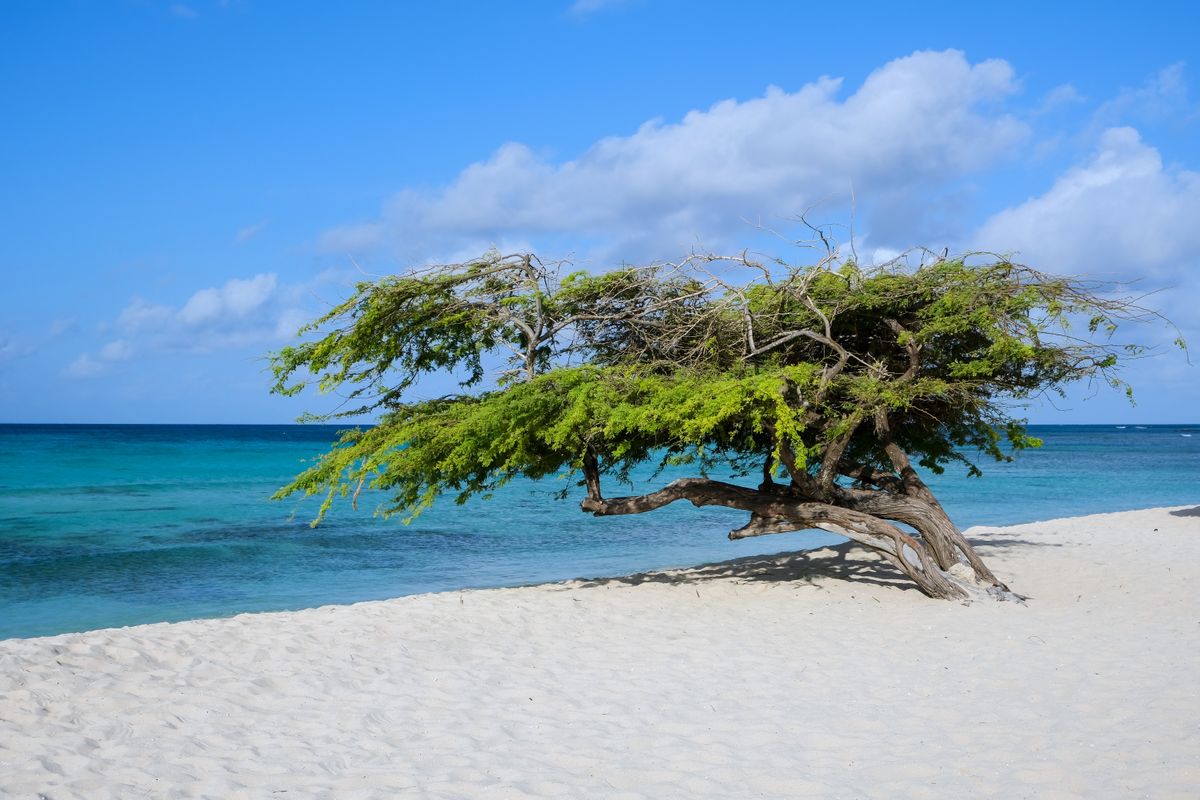
Aruba is one of the easier Caribbean destinations to reach from the United States — nonstop service from a broad set of east coast and southern cities, a flight of two to five hours, and one airport serving the whole island. The detail that makes it different from most Caribbean destinations is positional: Aruba sits outside the hurricane belt, which is why it markets itself as a year-round island rather than a seasonal one.
The short answer
Everything arrives at Queen Beatrix International (AUA), and nonstop service from the US is extensive. The island is arid, windy and warm year-round, and because it sits south of the main hurricane track, there is no true off-season for weather risk. The expensive period is mid-December to mid-April; the best value is May through August, when the weather is still good.
The airport
Queen Beatrix International (AUA) is on the western edge of the island, ten to fifteen minutes from Oranjestad and roughly 20 to 30 minutes from the high-rise hotel strip at Palm Beach.
It is a single-terminal airport with a US pre-clearance facility, which matters more than it sounds. You clear US immigration and customs in Aruba before boarding your return flight, which means your arrival back in the US is treated as a domestic arrival. That typically saves a long immigration queue on the US side — but it also means you should arrive at AUA earlier than you would for a comparable international return, because you are clearing both Aruban exit and US entry in one building.
The terminal was expanded and handles the traffic reasonably well, though it gets busy when several US flights depart in the same window.
Getting there from the US
Aruba has unusually good nonstop coverage for an island of its size, particularly from the eastern US. Typical nonstop times run roughly:
| From | Nonstop time |
|---|---|
| Miami / Fort Lauderdale | ~3 hours |
| New York / Boston / Washington | ~4.5 hours |
| Atlanta / Charlotte | ~4 hours |
| Chicago | ~5 hours |
| West coast | Connection required, 9–12 hours total |
Service from the west coast generally requires a connection, usually through a southern or eastern hub. Service from the northeast is frequent enough that you often have a choice of departure times, which matters for the timing point below.
Weather and when to go
Aruba's climate is the reason it can be sold year-round. It is dry — genuinely arid, with a landscape of cacti and divi-divi trees rather than rainforest — and the constant trade wind keeps the temperature tolerable even in summer.
- Temperature is stable. Daytime highs sit around 85–90°F all year with modest variation. There is no cool season.
- Rainfall is low and the wet season is mild. Most rain falls between October and December, and even then it is usually brief. This is not a Caribbean island with a washed-out season.
- The wind is constant. It makes the heat manageable and makes Aruba a genuine windsurfing and kitesurfing destination. It also means the leeward beaches are calm while the windward coast is rough.
- Hurricanes are rare. Aruba sits south of the main development zone and is only occasionally affected. This is a real advantage, not marketing — but "rare" is not "never," and a storm elsewhere in the Caribbean can still disrupt connecting flights.
The seasons that actually matter
| Period | Character | Price |
|---|---|---|
| Mid-Dec to mid-Apr | Peak. Best weather, most crowded | Highest — book early |
| May to Aug | Still dry and windy, hotter, quieter | Best value of the year |
| Sep to mid-Dec | Wettest and most humid, lowest crowds | Lowest, but watch storm disruption elsewhere |
For most travellers the calculation is straightforward: if you want the best combination of weather and price and have flexibility, May and June are the pick. If you need school holidays or reliable dry weather, you are in the peak window and should book accordingly.
When to book
Aruba is a leisure route, which means demand is concentrated into fixed periods rather than spread evenly. Two windows matter:
- Peak season, mid-December to mid-April. Book three to six months ahead. This is when the island fills, and the cheap fare buckets empty first. Christmas and New Year need longer still.
- Off-peak, May to November. The standard one to three months works. Competition between carriers keeps fares reasonable and there is less urgency — see how far ahead to book.
One route-specific point: because nonstop service is concentrated on the eastern seaboard, travellers from the west coast are effectively booking a connecting itinerary on a leisure route. That combination — one connection, fixed holiday demand — is where availability runs out before price rises.
Day of week matters here
Leisure routes show a stronger weekly pattern than business routes, and Aruba is a clear example. Saturday and Sunday departures carry the concentrated demand, because that is when resorts change over their weekly bookings. Tuesday, Wednesday and Saturday departures are typically cheaper, and shifting by a day can produce a meaningful difference — see which days are actually cheaper.
Documents and practicalities
Independent flight booking assistance service. Not affiliated with any airline. This is a toll-free number, free to call from anywhere in the US.
- Passport. US citizens need a valid passport. No visa is required for tourism.
- Embarkation and Disembarkation card. Aruba requires an online ED card to be completed before arrival, and there is a fee. Do this in advance — completing it at the airport is slower and the requirement is enforced.
- US pre-clearance on departure. You clear US immigration in Aruba before flying home. Arrive earlier than you would for a comparable flight and do not cut it fine if you have a connection in the US.
- Currency. The Aruban florin. US dollars are widely accepted across the island, and change is sometimes given in florins.
- Rental car. Useful if you want the windward coast and the national park. The island is small — you can drive its length in well under an hour.
What to check before you book
- Which US airport your nonstop uses. Coverage is concentrated on the east coast. If your nearest hub is not served nonstop, compare connecting options from a different origin — the difference can be larger than the drive.
- Resort fees and taxes. Common in Aruba and frequently excluded from headline rates. Compare totals rather than nightly prices — see packages versus booking separately.
- Whether a package beats booking separately. Aruba's resort concentration makes it a good candidate for bundling, and the saving usually comes from the hotel side — see how bundles are priced.
- Baggage allowance. Leisure routes often carry tighter allowances than business ones — see baggage rules.
- Fare flexibility. If your dates might move, avoid Basic Economy, which cannot be changed at all — see what Basic Economy excludes.
- Return connection buffer. With US pre-clearance in Aruba, allow generous time if you are connecting onward in the US after landing.
Frequently Asked Questions
What airport do I fly into for Aruba?
Queen Beatrix International (AUA), the island's only international airport. It is ten to fifteen minutes from Oranjestad and 20 to 30 minutes from the Palm Beach hotel strip.
Does Aruba get hit by hurricanes?
Rarely. Aruba sits south of the main Caribbean hurricane development zone, which is why it is marketed as a year-round destination. It is not immune — and a storm elsewhere in the Caribbean can still disrupt a connecting flight — but the risk is materially lower than on most Caribbean islands.
Are there direct flights from the US to Aruba?
Yes, with good nonstop coverage particularly from the eastern US — Miami, New York, Boston, Washington, Atlanta and Charlotte among others. West coast departures generally require a connection, adding up to nine to twelve hours total.
When should I book a flight to Aruba?
Three to six months ahead for the mid-December to mid-April peak, and one to three months for May through November. Christmas and New Year need longer, because demand concentrates on fixed dates and the cheap seats go first.
When is the cheapest time to go to Aruba?
May through August. The weather is still dry and the trade winds keep it comfortable, but the peak-season crowds and pricing have gone. September to mid-December is cheaper again but wetter, with more chance of disruption from storms elsewhere in the region.
Do I need a visa for Aruba?
US citizens do not need a visa for tourism, but do need a valid passport. Aruba also requires an online Embarkation and Disembarkation (ED) card completed before arrival, with a fee payable — do it in advance rather than at the airport.
Is there US customs in Aruba?
Yes. Aruba has a US pre-clearance facility, so you clear US immigration and customs before boarding your flight home, and your arrival in the US is treated as domestic. That saves a queue on arrival, but means arriving at the airport earlier than usual.
Which side of the island should I stay on?
Palm Beach and the high-rise strip have the calm leeward water and the resort concentration. The windward coast is rougher and better for windsurfing than swimming. Oranjestad suits people who want restaurants and town rather than a resort base.
Weighing a nonstop from a further airport against a connection from a closer one — plus a package against separate bookings — is more comparison than most people want to do by hand. If you would rather have it worked through for you, our agents can run the options in a single call.
Independent flight booking assistance service. Not affiliated with any airline. This is a toll-free number, free to call from anywhere in the US. Learn more