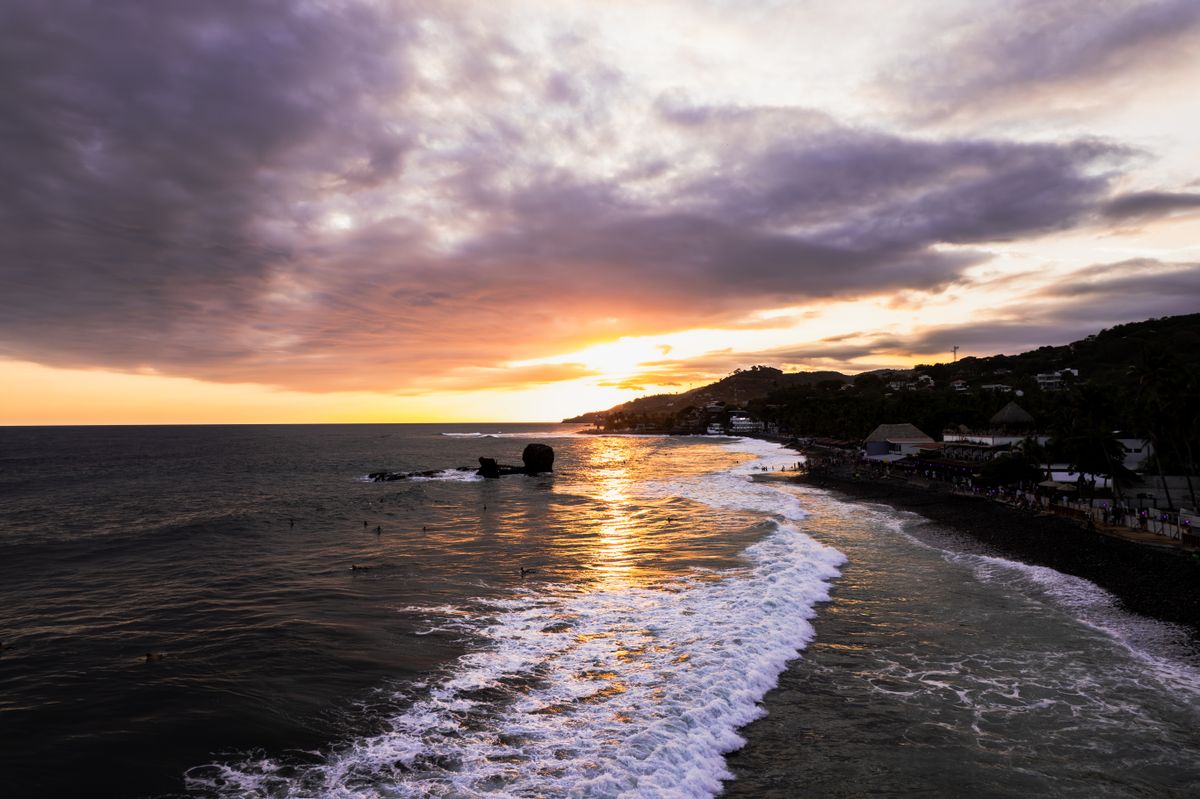
El Salvador is one of the least obvious destinations in Central America and one of the easier ones to actually get to. Nonstop service from a growing set of US cities, a flight of three to five hours, a dollarised economy, and a compact country where nothing is more than a few hours from the airport. What surprises people is not the logistics — it is how little they knew about it.
The short answer
Everything arrives at Monseñor Óscar Arnulfo Romero International (SAL), commonly called Comalapa. It is about 30 miles south of San Salvador, roughly 45 minutes by road. Nonstop service from the US has expanded considerably, particularly from the west coast and Texas. The dry season runs November to April; the rainy season from May to October brings afternoon downpours that are heavy but short.
The airport
Comalapa — officially Monseñor Óscar Arnulfo Romero y Galdámez International, code SAL — is the country's only international airport. It opened in 1980 and was built on a plateau well outside the capital, partly for reasons of terrain and partly because the country is small enough that a single airport serves it adequately.
That location is the main practical fact about it: you land 30 miles from San Salvador, and it takes 45 minutes to two hours to reach the city depending on traffic. The road is good; the traffic is not.
The terminal is compact and easy to navigate by international standards. It is not a hub, so you will not be dealing with a sprawling multi-terminal transfer. Arrivals and departures are in the same building.
Worth knowing: there is a departure tax, normally included in the airline ticket price. Confirm it is included rather than being asked for it in cash at check-in.
Getting there from the US
Nonstop coverage has grown substantially as US carriers expanded into Central America, and it is no longer a route you have to connect to from most of the country.
| From | Nonstop time |
|---|---|
| Houston | ~3 hours |
| Miami / Fort Lauderdale | ~2.5–3 hours |
| Dallas | ~3.5 hours |
| Los Angeles | ~5 hours |
| New York / Washington | ~4.5–5 hours |
| Atlanta | ~3.5 hours |
Competition on the route has grown, with both legacy carriers and low-cost operators present. That generally keeps fares reasonable, and it means you can often choose between a legacy carrier with a baggage allowance and a budget fare that charges for everything — see what Basic Economy excludes.
If your origin lacks nonstop service, connecting through a US hub is usually preferable to connecting inside Central America, because it keeps you on one ticket with protection if something goes wrong.
When to go and when to book
Seasons
| Period | Character | Notes |
|---|---|---|
| Nov to Apr | Dry season | Best weather, the peak for visitors |
| May to Oct | Rainy season | Heavy but short afternoon downpours; green, cheaper, quieter |
| Jun to Nov | Hurricane season | El Salvador is less exposed than the Caribbean, but Pacific systems can bring heavy rain |
The rainy season is often misjudged. It does not rain all day — mornings are typically clear, with heavy convective showers in the afternoon and evening. If your plans are outdoor and morning-based, the wet season is perfectly workable and considerably cheaper.
When to book
- December to April: two to four months ahead for the dry-season peak, and earlier around Christmas and Easter — Semana Santa is a major domestic travel period in El Salvador, and the country's own holiday traffic competes with yours.
- May to November: one to three months is usually sufficient. Demand is lower and inventory is comfortable — see how far ahead to book.
What people actually go for
Understanding this matters for timing, because the country's tourism is concentrated in two quite different things:
- Surfing. The Pacific coast around El Tunco and El Zonte has become a genuine destination, with consistent swell and warm water. The surf is best from March to October, which overlaps the rainy season — so the wet season is the good season for a surf trip.
- Volcanoes and highlands. Santa Ana, the Ruta de las Flores and the coffee highlands, best in the dry season when trails and views are clear.
Those two pull you toward opposite months, which is worth deciding before you book rather than after.
Independent flight booking assistance service. Not affiliated with any airline. This is a toll-free number, free to call from anywhere in the US.
Documents and practicalities
- Passport. US citizens need a valid passport. No visa is required for tourism.
- Currency. The US dollar. El Salvador dollarised in 2001, so there is no exchange-rate arithmetic to do — one of the genuinely convenient things about visiting.
- Language. Spanish. English is common in tourist areas and limited elsewhere.
- Ground transport at SAL. Use the official taxi rank or a pre-booked transfer. Ride-hailing apps operate but pickup arrangements at the airport vary.
- Safety. The security situation has changed significantly in recent years and travel advisories are updated regularly. Check the current official advice rather than relying on how the country was described a few years ago, in either direction.
- Departure tax. Normally included in the ticket. Verify before you travel.
What to check before you book
- Baggage allowance. Budget carriers on this route can undercut a legacy fare by less than the bag fee they add — see baggage rules.
- Arrival time versus the drive. A late arrival means a 45-minute drive in the dark. If you are heading straight to the coast rather than the capital, allow considerably more.
- Which season suits your plan. Surfing points you at March to October; volcanoes and highlands point at November to April. They do not overlap much.
- Fare flexibility. In hurricane season, a changeable fare is worth more than usual.
- Whether you need a car. The country is compact, but public transport is limited and most visitors hire a driver or a car for the highlands.
- Current entry requirements. Rules change. Check the official source shortly before departure rather than at booking.
Frequently Asked Questions
What airport do I fly into for El Salvador?
Monseñor Óscar Arnulfo Romero International (SAL), usually called Comalapa. It is the country's only international airport, about 30 miles south of San Salvador — 45 minutes to two hours by road depending on traffic.
Are there direct flights from the US to El Salvador?
Yes, and coverage has expanded — nonstop from Houston, Miami, Dallas, Los Angeles, New York, Washington and Atlanta among others. Competition on the route keeps fares reasonable, with both legacy and low-cost carriers present.
When is the best time to book a flight to El Salvador?
Two to four months ahead for the December to April dry season, and earlier around Christmas and Semana Santa, when domestic holiday travel competes for the same seats. One to three months is usually enough from May to November.
Do I need a visa to visit El Salvador?
No visa is required for US citizens travelling for tourism, but you need a valid passport. Check the current entry requirements shortly before departure, since these change.
Is El Salvador expensive?
It uses the US dollar, which removes exchange-rate uncertainty but also means prices are not as low as in some neighbouring countries. It remains considerably cheaper than the US for accommodation, food and transport.
When is surf season in El Salvador?
Roughly March to October, which overlaps the rainy season — so for a surf trip, the wet season is the good season. Mornings are usually clear, with heavy rain arriving in the afternoon.
Do I need a rental car in El Salvador?
Not necessarily, but public transport is limited and most visitors hire a car or a driver for the highlands. For a surf-focused trip based in one coastal town, you may not need one at all.
Deciding between the surf season and the dry season — and whether a budget fare or a legacy fare is actually cheaper once bags are counted — is more comparison than it looks. If you would rather have it run for you, our agents can work through it in one call.
Independent flight booking assistance service. Not affiliated with any airline. This is a toll-free number, free to call from anywhere in the US. Learn more