Switzerland is one of the more expensive places to fly into in Europe, and unlike Portugal or Iceland it has no real budget-carrier bridge from the US. The country has two international gateways, Zurich and Geneva, and which one you want depends entirely on which half of the country you are visiting.
The short answer
Zurich (ZRH) for central and eastern Switzerland — Zurich, Lucerne, Interlaken, the Bernese Oberland. Geneva (GVA) for the west — Geneva, Lausanne, Montreux, and access to the French Alps. Nonstop US service is limited and concentrated on Zurich, so many US travellers connect through a European hub. US citizens need a passport, no visa. Note that Switzerland uses the Swiss franc, not the euro.
Zurich or Geneva
Zurich (ZRH) — Zurich Airport
The larger of the two and the country's main long-haul gateway. It sits about 10 to 15 minutes from central Zurich by train, with a station directly under the terminal — one of the smoothest airport-to-city transfers in Europe.
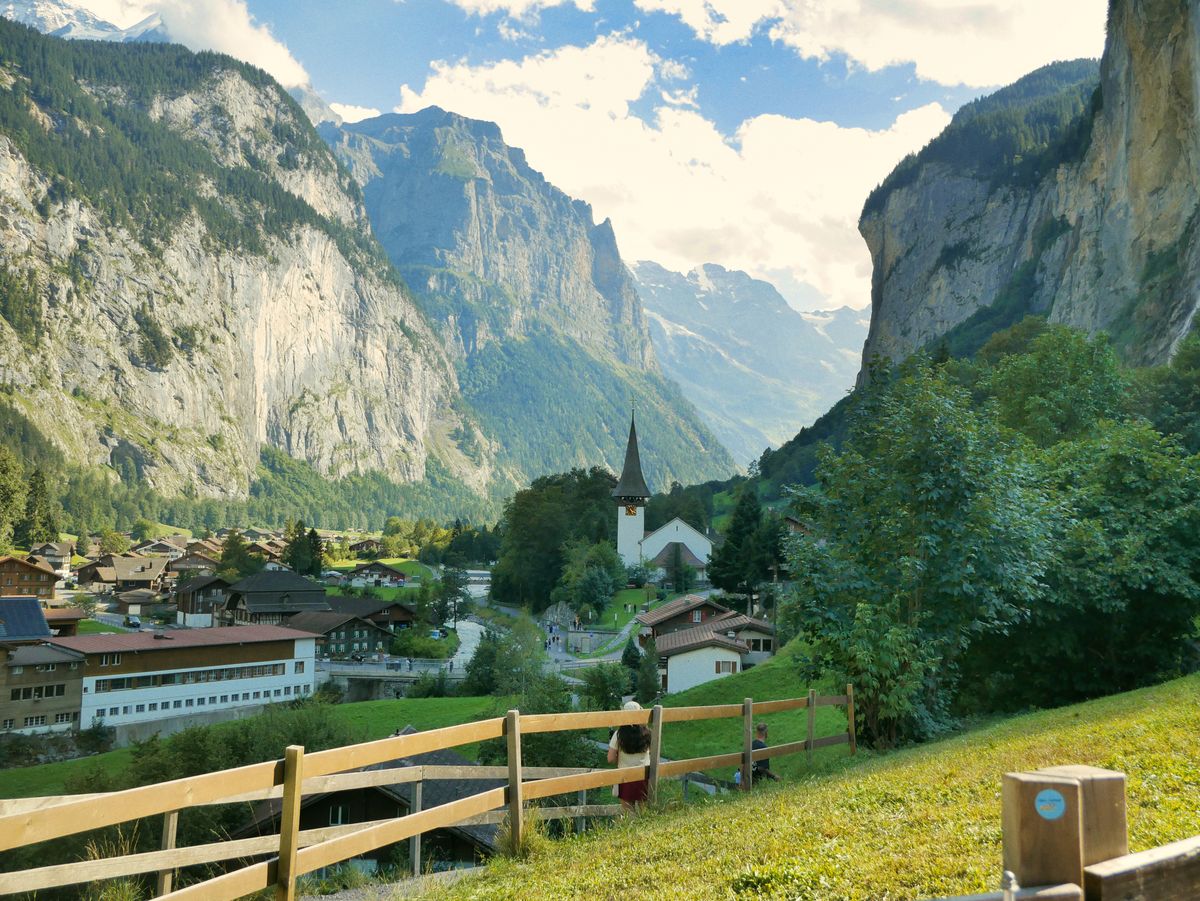
Zurich is the base for most of what people come to Switzerland for: Lucerne is under an hour by train, Interlaken about two, and the Bernese Oberland — Grindelwald, Lauterbrunnen, the Jungfrau region — is around two and a half to three hours.
Geneva (GVA) — Geneva Airport
The western gateway, serving Geneva, Lausanne, Montreux and the Lake Geneva region, plus the French Alps (Chamonix is about an hour away). It also sits close to the city — around 10 minutes by train.
Geneva has good long-haul service but less than Zurich from the US. It is a major hub for international organisations and humanitarian traffic, which gives it a different route profile from a purely leisure gateway.
Basel (BSL)
A third international airport serving the northwest, on the French and German borders. Limited long-haul service; useful mainly if your trip centres on Basel or the Alsace region.
| Zurich (ZRH) | Geneva (GVA) | |
|---|---|---|
| US nonstop service | Better | Limited |
| Distance to city centre | ~10–15 min by train | ~10 min by train |
| Serves | Lucerne, Interlaken, Bernese Oberland | Lausanne, Montreux, French Alps |
| Train between them | ~2.5–3 hours, frequent | |
Getting there from the US
| From | To ZRH | To GVA |
|---|---|---|
| New York / Newark | ~7.5–8 hours | ~8 hours |
| Boston / Washington | ~7.5–8 hours | Limited / seasonal |
| Chicago | ~9 hours | Seasonal |
| Los Angeles / San Francisco | ~11–12 hours | Connection required |
| Most other origins | Connect via a European hub | Connect via a European hub |
US nonstop service to Switzerland is considerably thinner than to London, Paris or Frankfurt. Zurich carries most of it; Geneva's is more seasonal and skewed toward the winter ski market and the summer lake season.
Connecting through a European hub is normal rather than unusual for this destination. If you do, note that Switzerland is in Schengen but not in the EU — you clear Schengen immigration on entry to the area, and the currency is different from the surrounding countries.
When to go and when to book
Seasons
| Period | Character | Price |
|---|---|---|
| Jun to Sep | Hiking, lakes, mountain railways open | Peak |
| Dec to Mar | Ski season, especially the west | Peak — and very expensive over Christmas and New Year |
| Apr to May | Shoulder; some high passes and lifts closed | Lower |
| Oct to Nov | Shoulder; quiet, some closures | Lowest |
Switzerland has two distinct peak seasons, and the shoulder months have a real drawback: mountain infrastructure closes. Many cable cars, high passes and mountain railways shut between roughly late October and early December, and again while snow conditions settle. If a specific mountain railway is the point of your trip, check it is running.
The shoulder months are also genuinely quiet — some lakeside towns feel shut in November. That is either appealing or a problem, depending on the trip you wanted.
When to book
- June to September: three to five months ahead. Summer is the main season and hotel capacity in Interlaken and the Oberland is genuinely constrained.
- December to March: three to five months ahead, and considerably earlier for Christmas, New Year and the February half-term weeks, which are the most expensive weeks of the Swiss year.
- April, May, October, November: one to three months is usually sufficient — see how far ahead to book.
Getting around once you are there
Switzerland's rail network is the reason many people visit, and it changes how you should book. Trains reach almost everywhere, run to the minute, and connect the airports directly. You often do not need a car, and in many mountain towns you cannot usefully use one.
If your trip involves several Swiss cities plus a neighbouring country, it is worth treating as a multi-city itinerary rather than a series of returns.
Independent flight booking assistance service. Not affiliated with any airline. This is a toll-free number, free to call from anywhere in the US.
Documents and practicalities
- Passport. US citizens need a valid passport. No visa for tourism. Switzerland is in Schengen but not the EU, so the 90-in-180-days rule applies to the Schengen area as a whole.
- Currency. The Swiss franc — not the euro. This catches people out, particularly if they are coming from or continuing into the eurozone. Cards are accepted almost everywhere.
- Cost. Switzerland is expensive, consistently and substantially. Food, accommodation and transport are all high; budget accordingly rather than being surprised.
- Trains. Excellent, punctual and the default way to travel. Airport stations are directly beneath the terminals at both Zurich and Geneva.
- Tipping. Service is included. Rounding up is normal; larger tips are not expected.
- Language. German in the centre and east, French in the west, Italian in the south. English is widely spoken.
What to check before you book
- Which airport matches your itinerary. Zurich and Geneva are nearly three hours apart by train — the wrong choice costs you half a day.
- Whether your origin has nonstop service at all. Much of the US connects via a European hub.
- Whether your mountain railway or cable car is running. Several close from late October to early December.
- That you have Swiss francs, not euros. Different currency from every country around it.
- Baggage allowance. Ski or hiking equipment is bulky, and the low-cost connections within Europe charge heavily for it — see baggage rules.
- Fare flexibility. Ski trips in particular are exposed to snow conditions — a changeable fare has real value. Basic Economy cannot be changed at all. See what Basic Economy excludes.
Frequently Asked Questions
Which airport should I fly into for Switzerland?
Zurich (ZRH) for central and eastern Switzerland — Lucerne, Interlaken and the Bernese Oberland. Geneva (GVA) for the west — Lausanne, Montreux and the French Alps. Zurich has more US nonstop service; both sit about ten minutes from their city centres by train.
Are there direct flights from the US to Switzerland?
Limited. Zurich has the most, from New York, Newark, Boston, Washington and Chicago among others, with nonstop times of roughly 7.5 to 9 hours. Geneva's service is thinner and more seasonal. Most other US origins connect through a European hub.
When is the best time to book a flight to Switzerland?
Three to five months ahead for both the June to September summer season and the December to March ski season. Christmas, New Year and the February half-term weeks are the most expensive periods of the Swiss year and need booking earliest.
Do I need a visa for Switzerland?
No visa is required for US citizens travelling for tourism, but you need a valid passport. Switzerland is in the Schengen area but not the EU, and the 90-days-in-180 rule applies across the whole Schengen area.
Can I use euros in Switzerland?
You should not rely on it. The currency is the Swiss franc, and while some tourist businesses may accept euros, the rate is usually poor. Cards are accepted almost universally, which is the simplest approach.
Do I need a car in Switzerland?
Usually not. The rail network reaches almost everywhere, runs exactly on time, and connects both airports directly. In many mountain towns a car is more hindrance than help, and some are car-free.
What is closed in the shoulder season?
Many cable cars, mountain railways and high passes shut from roughly late October to early December, and some lakeside towns become very quiet. If a specific mountain railway is the reason for your trip, confirm it is running before booking.
Is Switzerland expensive?
Yes, consistently — food, accommodation and transport are all substantially more expensive than neighbouring countries. It is not a destination where careful planning changes the overall cost much, so budget for it rather than searching for bargains.
Switzerland's two gateways, two peak seasons and mid-season mountain closures make the timing genuinely fiddly — and the wrong airport costs half a day. If you want that worked through against your actual plans, our agents can run it with you in one call.
Independent flight booking assistance service. Not affiliated with any airline. This is a toll-free number, free to call from anywhere in the US. Learn more