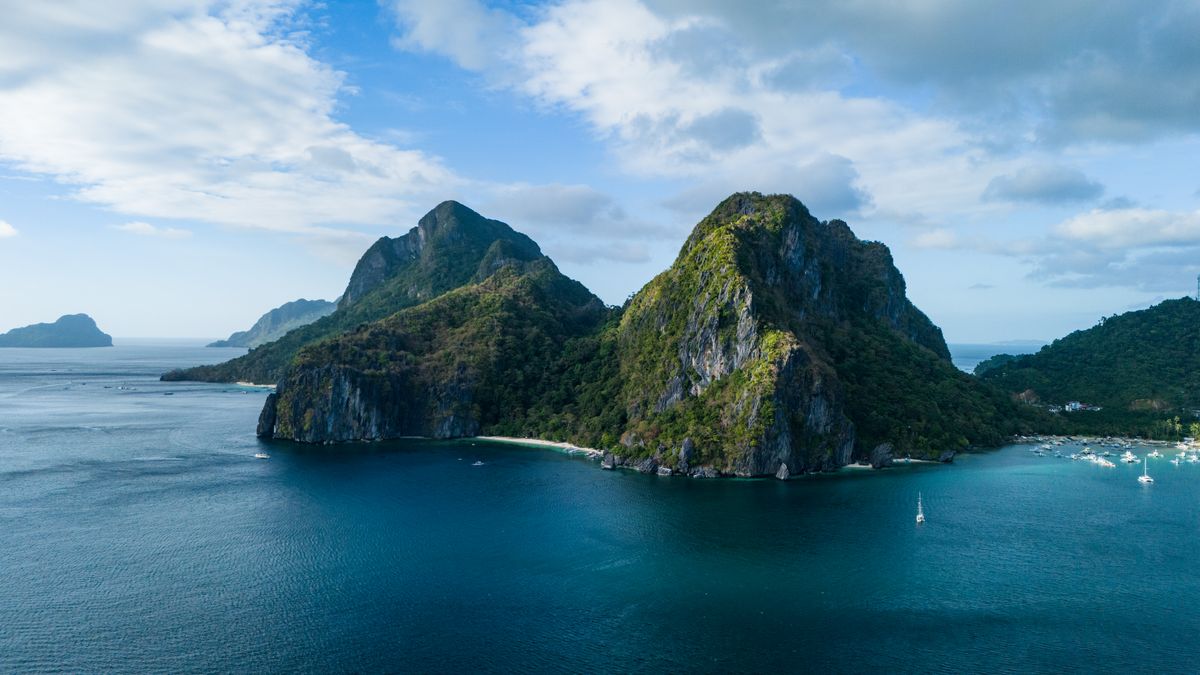
The Philippines is the longest journey most Americans will make outside of a deliberate round-the-world trip. There is no nonstop service from the US, every itinerary connects, and the journey is complicated further by the fact that Manila is rarely the final destination — the country is 7,000 islands, and most visitors are heading somewhere beyond the capital.
The short answer
There is no nonstop service from the US to the Philippines. Every itinerary connects, usually through East Asia or the Gulf, with total travel time of roughly 18 to 24 hours. Manila (MNL) is the main gateway; Cebu (CEB) has some international service. Book three to six months ahead. The dry season runs roughly December to May; the typhoon season is June to November. US citizens need a passport, no visa for tourism.
The main airports
Manila — Ninoy Aquino International (MNL)
The primary gateway and the busiest airport in the country, though not the most pleasant. It has four terminals that are not connected by a walkable route, which makes transfers between them genuinely awkward — a detail worth knowing if your itinerary involves a self-transfer.
Manila is also the hub for the extensive domestic network, so if you are continuing to Palawan, Boracay, Bohol or Siargao, you will most likely pass through here.
Cebu — Mactan-Cebu International (CEB)
The second gateway, in the central Visayas. Some international service, mostly regional Asian routes. If your trip centres on the Visayas — Cebu, Bohol, Negros, Siargao — arriving via Cebu can save a domestic connection, but from the US you will usually still transit Manila or a foreign hub.
Clark — Diosdado Macapagal International (CRK)
A former US air base north of Manila, now with limited international service, mostly regional low-cost carriers. Occasionally useful for northern Luzon; not a practical US gateway.
Getting there from the US
There is no nonstop service, so every itinerary involves at least one connection:
| Routing via | Typical total time from US | Notes |
|---|---|---|
| East Asia (Tokyo, Seoul, Hong Kong, Taipei) | 18–22 hours | Frequently the fastest elapsed time; strong carriers |
| The Gulf (Dubai, Doha, Abu Dhabi) | 20–24 hours | High service standards, purpose-built transfer hubs |
| US west coast hub | 18–20 hours | One stop, one ticket, simpler baggage rules |
| Southeast Asia (Singapore, Bangkok) | 20–24 hours | Often competitive on price; longer elapsed time |
The west coast has a genuine advantage on this route — Los Angeles, San Francisco and Seattle cut several hours off the journey compared with the east coast, and most of the efficient routings start there.
From the east coast, expect to add three to five hours, and consider whether a US domestic connection to a west coast gateway is better than an eastbound routing.
Domestic connections, which are the real complexity
Most visitors are not staying in Manila. The country's geography means that if you are going to Palawan, Boracay, Bohol, Siargao or the rice terraces, you have a domestic flight in your future — and these come with their own rules.
- Domestic baggage allowances are stricter than international ones, and the low-cost carriers that dominate domestic routes charge heavily for checked bags.
- Terminal transfers at Manila are awkward. The four terminals are not connected by a walkable route, and transferring between them requires a taxi and considerable time.
- Weather delays are common in typhoon season, and domestic flights are the first affected.
- Book domestic legs early around Christmas, Easter and the major Filipino holidays — the domestic network fills with local travel and there is no alternative capacity.
If your itinerary involves connecting from an international arrival to a domestic departure, allow far more time than the connection looks like it needs. A same-day international-to-domestic connection through Manila is possible but tight, and an overnight is often the sensible choice.
When to go and when to book
Seasons
| Period | Character | Price |
|---|---|---|
| Dec to May | Dry season, best weather | Peak — highest, book earliest |
| Mar to May | Hot and dry; some call this summer | Busy, especially Easter |
| Jun to Nov | Typhoon season, wettest | Cheapest, but real disruption risk |
The typhoon season is not a technicality here. The Philippines sits directly in the western Pacific typhoon belt and is hit by more tropical cyclones than almost any country on earth. That does not make the wet season unusable — many trips go fine — but it does mean building in flexibility, and it explains why fares drop so sharply.
Note also that the country is large enough that weather varies considerably. Palawan and the Visayas have different patterns from Luzon, and the southern islands are less affected by northern typhoon tracks.
When to book
Independent flight booking assistance service. Not affiliated with any airline. This is a toll-free number, free to call from anywhere in the US.
- December to May: three to six months ahead. Christmas is the single busiest period, because it is both the peak tourist season and the main Filipino family holiday.
- June to November: one to three months, though check fare flexibility given the weather risk — see how far ahead to book.
Documents and practicalities
- Passport. US citizens need a valid passport, with at least six months of validity remaining. No visa for tourism stays under 30 days.
- Proof of onward travel. Often required on entry. Have your return or onward ticket accessible.
- Currency. The Philippine peso. Cards are widely accepted in cities and resorts; cash matters on smaller islands.
- Terminal transfers at MNL. The terminals are not walkable. Allow a taxi and significant buffer if you are self-transferring.
- Domestic baggage. Stricter and more expensive than international. Pre-pay online rather than at the airport — see baggage rules.
- Island transfers. Getting between islands often means a flight, a ferry, or both. Ferries are cheap and slow; schedules are weather-dependent.
What to check before you book
- Whether you actually need to route through Manila. If your destination is in the Visayas, arriving via Cebu can save a connection.
- Total elapsed time. The routings differ by hours, and a cheaper fare with a long layover is not a cheaper trip.
- Connection protection. Never book an international and a domestic leg on separate tickets without a large buffer. See how connections work.
- Your international-to-domestic connection time. Manila's terminal transfers are slow, and a same-day connection is tight.
- Domestic baggage allowance. It is stricter than the international leg, and the most common surprise on this route.
- Onward-travel proof and passport validity. Six months of validity is required — see the international checklist.
- Fare flexibility in typhoon season. Basic Economy cannot be changed at all, which is a genuine risk from June to November — see what Basic Economy excludes.
Frequently Asked Questions
Are there direct flights from the US to the Philippines?
No. There is no nonstop service between the US and the Philippines. Every itinerary connects at least once, usually through East Asia — Tokyo, Seoul, Hong Kong or Taipei — or through a Gulf hub, with total travel time of roughly 18 to 24 hours.
Which airport should I fly into for the Philippines?
Manila (MNL) is the main gateway and the domestic hub. Cebu (CEB) has some international service and is a better arrival point if your trip centres on the Visayas, though you will usually still transit Manila or a foreign hub from the US.
How long is a flight to the Philippines from the US?
There is no nonstop, so total travel time runs about 18 to 24 hours depending on routing and layover. The US west coast has a genuine advantage — Los Angeles, San Francisco and Seattle cut several hours off the journey.
When is the best time to book a flight to the Philippines?
Three to six months ahead for the December to May dry season, with Christmas being the single busiest period. From June to November one to three months is usually enough, but check fare flexibility because it is typhoon season.
Do US citizens need a visa for the Philippines?
No visa is required for tourism stays under 30 days, but you need a passport with at least six months of validity remaining. Proof of onward travel is often required on entry.
What is the typhoon season like in the Philippines?
June to November. The Philippines is hit by more tropical cyclones than almost any country, which is why fares drop sharply in those months. Weather varies considerably between regions — Palawan and the southern islands are less affected by northern typhoon tracks.
Do I need a domestic flight within the Philippines?
Probably. Most visitors are not staying in Manila, and getting to Palawan, Boracay, Bohol, Siargao or the rice terraces means a domestic flight. Domestic baggage allowances are stricter than international ones and the low-cost carriers charge heavily for bags.
How do I transfer between terminals at Manila airport?
The four terminals are not connected by a walkable route, so transfers require a taxi and considerable time. If you are connecting from an international arrival to a domestic departure, an overnight is often more sensible than a tight same-day connection.
A US–Philippines itinerary combines a long-haul connection with a domestic leg and often an island transfer, and the routing choices differ by hours. If you want that unpicked against your actual plans, our agents can work through it with you in one call.
Independent flight booking assistance service. Not affiliated with any airline. This is a toll-free number, free to call from anywhere in the US. Learn more